Integrated Upstream Project Delivery Models
In the capital-intensive, high-risk, and technically demanding Upstream sector, project execution requires more than standard engineering—it demands financial ingenuity, logistics excellence, and advanced risk management.
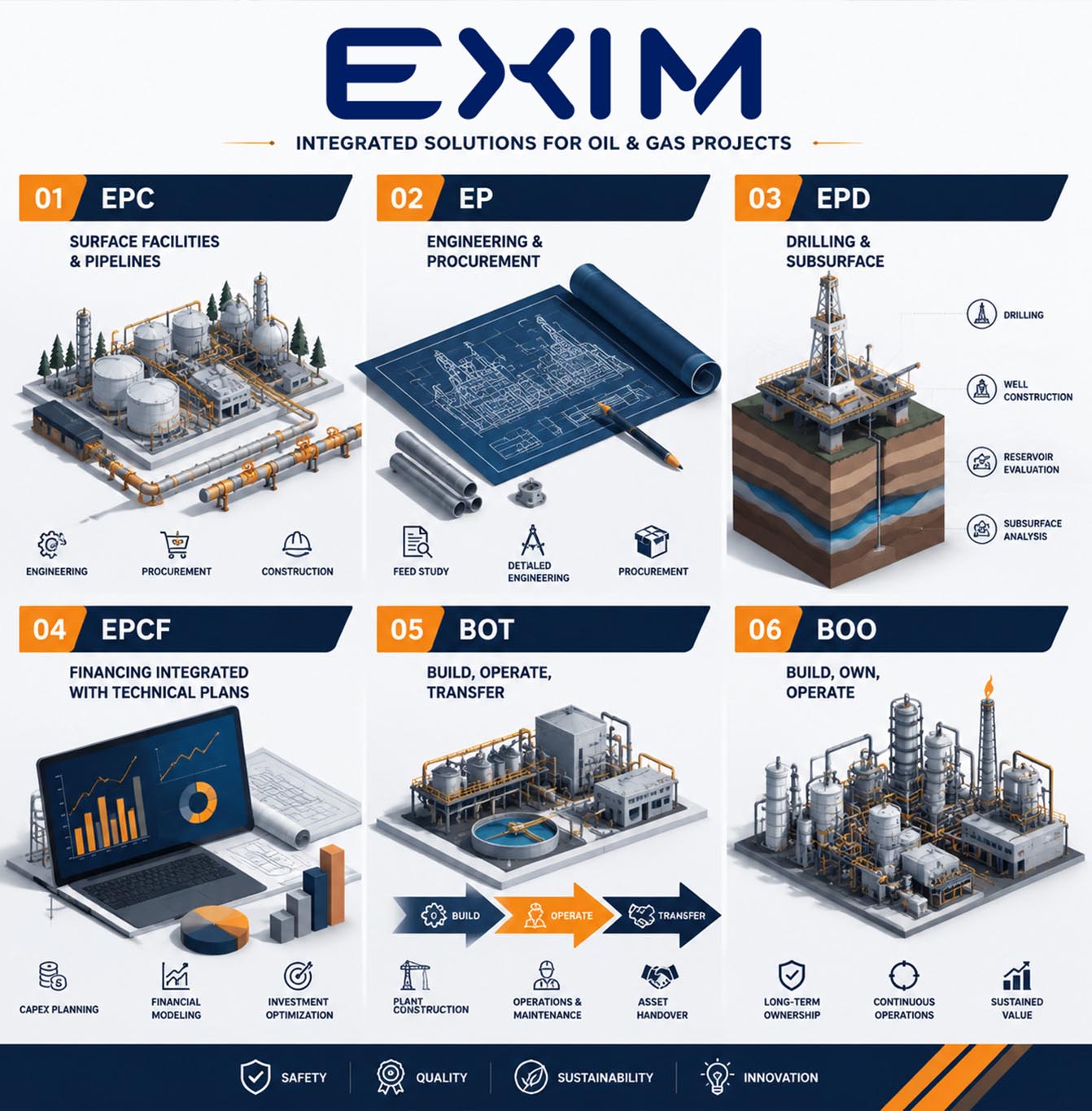
Exim offers a versatile suite of project delivery frameworks designed to optimize CAPEX, reduce OPEX, mitigate subsurface risks, and accelerate the timeline to First Oil and First Gas. These models integrate subsurface geology, drilling engineering, surface facilities, and capital markets into unified execution systems.
1. EP & EPC (Engineering, Procurement, and Construction)
Exim delivers full lifecycle responsibility for upstream surface facilities, infrastructure, and processing plants, ensuring seamless integration from wellhead to export pipeline.
- Engineering & Procurement (EP): FEED and detailed engineering across process, mechanical, piping, electrical, instrumentation, and structural disciplines. Strategic global sourcing of long-lead items including high-pressure manifolds, multiphase flow meters, separators, chemical injection skids, and MOL pumps compliant with API, ASME, and NACE standards.
- EPC Turnkey Execution: Full accountability for schedule, cost, quality, and safety across construction and commissioning phases.
- Facilities Delivered:
- Wellhead platforms and offshore jackets
- Flowlines and trunklines
- Gas-Oil Separation Plants (GOSPs)
- Produced water injection systems
- Commissioning: Advanced CMS-based cold and hot commissioning ensuring safe and optimized startup.
2. EPD (Engineering, Procurement, and Drilling)
The EPD model integrates drilling operations with surface engineering into a unified delivery system.
- Well Engineering: Full lifecycle well design including trajectory planning, casing design, mud program, and cementing tailored to HPHT conditions.
- Rig & Services: Mobilization of land rigs, jack-ups, and semi-submersibles, plus MWD, LWD, directional drilling, RSS, and smart completion systems.
- Risk Management: Absorption of drilling risks such as stuck pipe, mud loss, and tool failure with performance-based delivery models (cost per foot or time-depth metrics).
3. EPCF (Engineering, Procurement, Construction, and Financing)
The EPCF model integrates engineering execution with structured international financing solutions to overcome capital constraints.
- Financial Structuring: Collaboration with investment banks, ECAs, DFIs, and private equity institutions to arrange syndicated loans, buyer’s credit, and deferred payment structures.
- Production-Backed Financing: Repayment aligned with production output, enabling self-financing upstream assets.
- Integrated Delivery: Seamless coordination between developers, contractors, and financiers from feasibility to production.
4. BOT & BOO (Build-Operate-Transfer / Build-Own-Operate)
Infrastructure-as-a-service models designed to reduce CAPEX burden and optimize operational efficiency.
- BOO Model: Exim finances, builds, owns, and operates facilities such as EPFs, gas recovery units, and MOPUs with throughput-based tariffs.
- BOT Model: Full lifecycle delivery with defined concession periods, KPI-based operation, and final asset transfer with trained local workforce.
Why Partner with Exim?
- Subsurface-to-Surface Integration: Unified reservoir, drilling, and surface engineering execution.
- Advanced Project Management: Earned value management, strict QA/QC, and world-class HSE standards.
- Flexible Financial Structures: EPCF, BOT, and BOO models to unlock capital-constrained or stranded assets.